It's 6.40am, the alarm is going and you've technically had eight hours. So why does it feel like you've been hit by a bus?
Lots of Australians know that feeling. More than half say they don't sleep well on at least three nights a week, according to the Sleep Health Foundation's 2026 Aussie Sleep Snapshot.³
When people were asked what was getting in the way, 41 per cent pointed to a busy mind. In other words, for plenty of us the body is more than ready for bed. It's the brain that hasn't got the message.
When your mind won't clock off
It makes sense, really. Most of us spend the day juggling work, family and a group chat that never quite goes quiet, and there's rarely a moment to process any of it until the lights go out.
So you lie there replaying a conversation from the office, or working out what's for dinner tomorrow night.
For others, sleep comes easily enough but doesn't seem to do its job. You drift off, sleep through and still wake up feeling flat – then wonder whether the problem is you.
Of course, a rough night here and there is part of life. It's when poor sleep becomes your normal that it's worth a closer look.
A few sleep myths worth letting go of
'More hours in bed means better sleep.' Not necessarily. Most adults need about seven to nine hours a night, but if those hours are broken, you can still wake up tired.⁴
'Nodding off the second your head hits the pillow is a good sign.' It might feel like a win, but falling asleep almost instantly may mean you're not getting enough sleep.⁵
'A glass of wine helps you sleep.' A nightcap might feel as though it helps you drift off, but alcohol can disrupt your sleep cycles and leave you with poorer-quality sleep. It's best avoided for at least four hours before bed.⁴
'Scrolling helps me switch off.' Phones, computers and TV can all disrupt your sleep. Try setting aside a screen-free 'buffer zone' before bed and doing something relaxing instead.⁴
A few everyday habits help too: going to bed and getting up at around the same time each day, skipping caffeine for three to seven hours before bed, and keeping your bedroom quiet, dark and at the right temperature.⁴
Why quality matters as much as quantity
Sleep isn't just downtime. It's when your body repairs and regenerates tissue, and it runs in cycles of about 90 minutes that include deep sleep.⁴
That's why the number on the clock doesn't tell the whole story. A racing mind, a snoring partner or a child who wanders in during the night can break up those cycles, so even a long night can leave you feeling as though you've barely slept.
What to look for in a sleep supplement
If you're considering a sleep supplement, here's what to check on the pack:
- An AUST L number. This shows the product is listed in the Australian Register of Therapeutic Goods (ARTG).
- Ingredients you can look up. Branded, clinically studied ingredients come with published research you can read for yourself.
- The sugar content. Worth a look if you'll be taking it every night.
- Sensible claims. Words like 'cure' and 'fix' are a red flag.
- Where it's made. Handy to know if buying Australian matters to you.
Most of all, look for a brand that's upfront about what's in the product and what the research does – and doesn't – show.
Meet Eimele Sleep
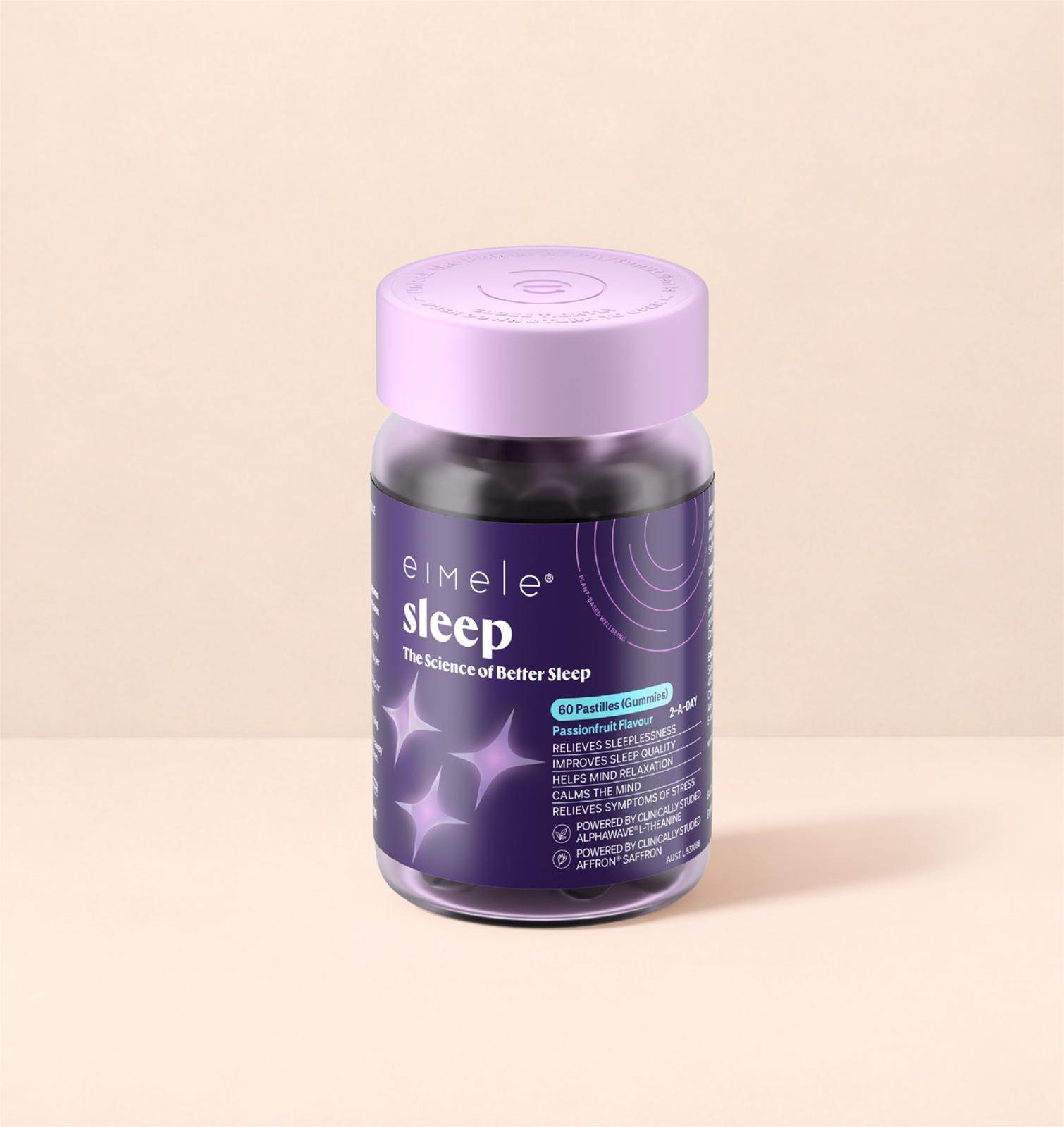
Eimele, the Australian brand partnering with Prevention on this article, has built its new Sleep pastilles around two ingredients that each come with their own published research. The pastilles relieve sleeplessness and improve sleep quality.
Eimele Sleep is listed in the ARTG, AUST L 531086. The pastilles are formulated and made in Australia, and they're 99 per cent sugar-free.
Each pastille contains 100mg of AlphaWave® L-theanine and 14mg of affron® saffron (Crocus sativus L.) stigma extract, plus vitamin B6. The label dose for adults is two pastilles a day.
So what’s a pastille? It’s a soft, chewable dose form – much like a gummy to look at, but denser, which allows each one to carry a measured dose of both ingredients. You chew them rather than swallowing them whole, and ‘pastille’ is the form Eimele Sleep is listed under in the ARTG.
What the research says
L-theanine, an amino acid found in tea leaves, was tested in a small trial led by researcher Malkanthi Evans and funded by AlphaWave's maker, Ethical Naturals.
The 16 healthy adults in the study, all with moderate stress, took a single 200mg dose of AlphaWave L-theanine on one occasion and a placebo on another – and neither they, the researchers nor the people analysing the results knew which was which.
After a stressful task, their levels of the stress hormone cortisol dropped further after L-theanine than after the placebo. Compared with the placebo, they also showed more alpha brain wave activity three hours after taking L-theanine – a pattern linked to a relaxed but alert state.¹
Interestingly, when asked how stressed they felt, the volunteers reported no difference between taking L-theanine and the placebo. So the changes showed up in their bodies' stress markers rather than in how they said they felt – and with one dose in a small group, it's an early finding rather than the final word.
The saffron extract was put to the test in adults who said they were sleeping poorly. In the trial, which was led by researcher Adrian Lopresti and funded by affron's maker, Pharmactive, people took 14mg twice a day for 28 days.
Compared with those on a placebo, they reported better sleep quality and bigger improvements on a standard sleep questionnaire.² Because those results come from people rating their own sleep over four weeks, they speak to something most of us care about: how well we feel we're sleeping.
Importantly, the two pastilles a day on the label give you the same amounts used in these trials: 200mg of L-theanine and 28mg of saffron extract. The studies looked at each ingredient on its own, rather than the two combined in Eimele Sleep.
Good to know
If a busy mind is keeping you awake, Eimele Sleep also helps calm the mind and relieve symptoms of stress.
The pastilles are designed for adults and aren't recommended during pregnancy or breastfeeding. And if sleepless nights are becoming a regular occurrence, or you're finding it harder to get through the day, it's worth having a chat with your health professional.
After all, a good night's sleep can make a world of difference to how you feel. And taking steps to look after yours is always time well spent.
Find out more at eimele.com.
ALWAYS READ THE LABEL AND FOLLOW THE DIRECTIONS FOR USE.
This article was created in partnership with Eimele. Prevention only partners with brands we believe in and that share our vision to provide science-backed content you can trust.
References
- Evans M, McDonald AC, Xiong L, Crowley DC, Guthrie N. A randomized, triple-blind, placebo-controlled, crossover study to investigate the efficacy of a single dose of AlphaWave® L-theanine on stress in a healthy adult population. Neurol Ther. 2021;10:1061–1078. DOI: 10.1007/s40120-021-00284-x. Funded by Ethical Naturals Inc.
- Lopresti AL, Smith SJ, Metse AP, Drummond PD. Effects of saffron on sleep quality in healthy adults with self-reported poor sleep: a randomized, double-blind, placebo-controlled trial. J Clin Sleep Med. 2020;16(6):937–947. DOI: 10.5664/jcsm.8376. Funded by Pharmactive Biotech Products.
- Sleep Health Foundation. Aussie Sleep Snapshot Survey 2026, released 3 August 2026. sleephealthfoundation.org.au
- healthdirect Australia. Sleep. healthdirect.gov.au/sleep: adults need about 7–9 hours; alcohol can disrupt sleep cycles; computers, phones and TV can disrupt sleep; sleep lets the body repair and regenerate tissues; cycles of about 90 minutes.
- Sleep Foundation. Sleep latency, medically reviewed by Anis Rehman MD. sleepfoundation.org: "Falling asleep almost immediately may be a sign of insufficient sleep."

 Newsletter