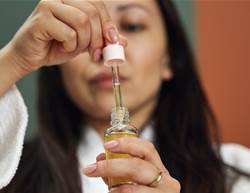
Even if you follow the latest skincare trends closely, the idea of putting salmon sperm on your face can sound confronting. But salmon sperm skincare, also known as PDRN skincare, has moved well beyond niche beauty chatter.
The K-beauty trend first gained attention overseas through in-clinic treatments, where the ingredient is used as a skin booster to support a smoother, fresher-looking complexion. Since then, PDRN has started appearing in professional treatments and topical skincare, including serums, moisturisers and face masks.
So, what is PDRN skincare, and how does it work?
Ahead, dermatologists explain what to know about PDRN skincare, its potential benefits and whether it is worth trying.
What is PDRN skincare?
PDRN stands for polydeoxyribonucleotide. It is a skincare ingredient derived from salmon DNA.
“PDRN—which stands for polydeoxyribonucleotide—“is an ingredient used in skincare products that is derived from the DNA of salmon (yes, the fish) and is thought to be so similar to human DNA that our skin cells can easily incorporate the instructions and produce material in abundant quantities,” explains board-certified dermatologist Dr Nava Greenfield.
So, yes, PDRN is often described as salmon sperm skincare. The idea is that the DNA fragments in PDRN may help support the skin’s natural repair processes.
“Think of it like a coach for your skin cells—helping them recover, rebuild, and function at their best,” says clinical professor of dermatology Dr Mona Gohara. “Early research suggests PDRN may support wound healing, collagen production, and reduction of inflammation.”
PDRN is now one of the buzziest ingredients in skincare, which means you may see it in products designed for daily use, such as serums, moisturisers and face masks. Historically, though, it has often been used in professional treatments such as microneedling, where tiny channels are created in the skin to help ingredients penetrate more effectively.
“In microneedling, tiny holes are created in the skin, which provide a pathway to penetrate through the outer skin layer,” explains associate professor of dermatology and director of cosmetic and clinical research in dermatology Dr Joshua Zeichner. “Microneedling on its own, or in combination with boosters like salmon sperm,…is one of the core treatments we have to stimulate collagen…In this process, new collagen is produced, which ultimately improves the appearance of lines and wrinkles and can improve sagging skin.”
While professional treatments may be effective for some people, they are not instant fixes. Visible changes can take weeks or months.
“I tell my patients this treatment is not like running a sprint, but rather keeping a steady pace in a marathon,” Dr Zeichner says.
There are also risks to consider. Any treatment that punctures the skin, including microneedling, can carry a risk of irritation, infection and post-treatment sensitivity. It can also be uncomfortable. For that reason, microneedling should only be performed by a qualified skincare professional in a safe clinical setting.
What are the benefits of PDRN skincare?
When used properly, PDRN may offer benefits for different skin types and concerns. Early research and dermatologists suggest it may help:
- improve skin hydration
- reduce redness
- support the skin barrier
- improve skin texture and firmness
- soften the look of wrinkles, fine lines and other visible signs of ageing
- support collagen production
- improve skin recovery
That said, PDRN is still a newer skincare ingredient for everyday topical use. Results may vary depending on the product, concentration, delivery method and your skin’s starting point.
Should anyone avoid PDRN skincare?
PDRN skincare will not suit everyone.
“Most people can use PDRN-containing products, but anyone with a known allergy to ingredients in the formula should avoid them,” Dr Gohara says.
If your skin is sensitive or highly reactive, do a patch test before using PDRN on your whole face. Apply a small amount to a discreet area, such as behind the ear or along the jawline, then wait 24 to 48 hours to check for redness, stinging, itching or swelling.
“Those with inflammatory skin conditions such as eczema, psoriasis, or rosacea should proceed with caution and check with their dermatologist before incorporating a new product into their routine, especially during a flare,” Dr Gohara adds. “As with any skincare ingredient, irritation is possible, although it is generally well-tolerated.”
If you are pregnant, breastfeeding, using prescription skin treatments, or recovering from a procedure, check with your dermatologist or GP before adding a new active ingredient.
How to try PDRN skincare
If you want to try PDRN without committing to an in-clinic treatment, topical products may be the easiest entry point. PDRN now appears in over-the-counter skincare such as serums, creams and masks.
“I love skincare products that multitask, and PDRN fits nicely into that category, since it can help support hydration, barrier function, and skin recovery in a single step.” Dr Gohara says. “Look for products from reputable brands with transparent ingredient lists, and pair them with daily sunscreen for the best results."
Dr Greenfield recommends keeping the routine simple. Look for a serum or cream where PDRN is one of the main active ingredients, rather than combining it with too many other actives at once.
“If it’s a serum, use after cleansing and before moisturizer. You can use it once or twice a day.”
If you want to try microneedling with PDRN, see a qualified professional. At-home microneedling can be risky, especially when paired with products designed only for surface application.
“Many people are combining these [over-the-counter products] with at-home microneedling to enhance penetration, but I am cautious in recommending this,” Dr Zeichner says. “These [products] are designed for topical application, not injection. Deep penetration into the skin theoretically could result in inflammatory reactions.”
Dr Gohara also notes that topical PDRN products have not been studied as extensively as in-clinic treatments.
“The drawback is that over-the-counter products have not been studied as extensively as in-office treatments, so results can vary,” she explains.
PDRN may be a promising ingredient for hydration, barrier support and skin recovery, but it is not magic. Start slowly, use sunscreen daily and avoid pairing it with aggressive treatments unless a qualified professional is guiding you.

 Newsletter

_(1).jpg&h=90&w=90&c=1&s=1)